Concrete Sleeper Retaining Walls Explained
Why concrete sleepers dominate the Australian retaining wall market. Understand the pros, cons, height limits, drainage essentials, and when they're the right choice for your property.
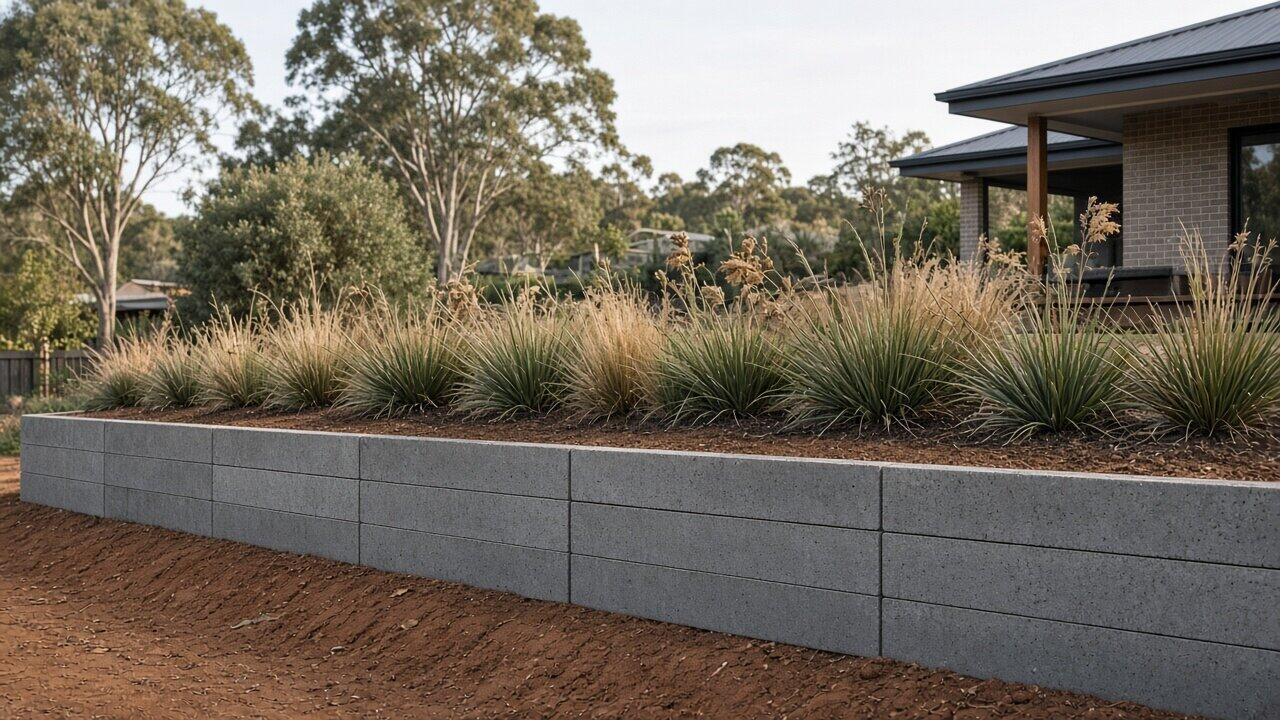
Concrete sleepers have become the go-to retaining wall solution for Australian properties, and for good reason. They combine the natural appearance of timber with none of the maintenance headaches, offering a durable, cost-effective solution for most residential retaining needs.
If you’re considering a retaining wall for your sloped block or terraced garden beds, understanding why concrete sleepers dominate the market - and when they’re not the right choice - helps you make informed decisions about your property.
Why Concrete Sleepers Dominate
Walk through any new Australian suburb and you’ll see concrete sleepers everywhere. This market dominance isn’t accidental.
The Timber Alternative Without Timber Problems
Concrete sleepers were designed to replicate the look of timber railway sleepers whilst eliminating their major drawbacks:
No rot or decay:
- Timber sleepers, even treated, eventually succumb to moisture and decay
- Concrete doesn’t rot, regardless of soil contact or moisture exposure
- Particularly valuable in Peninsula clay soils where drainage creates constant moisture
No termite risk:
- Australian termites can devastate timber retaining walls
- Concrete is completely termite-proof
- One less structural concern for homeowners
Fire resistance:
- Critical in bushfire-prone areas
- Concrete sleepers meet BAL (Bushfire Attack Level) requirements
- Timber sleepers often prohibited in high-risk zones
Consistent appearance:
- Every sleeper is identical in size and colour
- No warping, twisting, or splitting
- Retaining wall looks uniform for its entire life
Cost-Effective Long Term
Whilst concrete sleepers cost more upfront than basic treated pine, the total cost of ownership heavily favours concrete:
Initial cost comparison (approximate):
- Treated pine sleepers: $40-60 per sleeper
- Concrete sleepers: $60-90 per sleeper
- Premium hardwood sleepers: $100-200+ per sleeper
But over 20 years:
- Timber requires replacement at 15-20 years (sooner in poor drainage)
- Concrete lasts 50+ years with no deterioration
- No maintenance costs (oiling, sealing, replacing damaged sections)
For a medium retaining wall (30 sleepers), spending an extra $600-900 upfront eliminates a $2,000-3,000 replacement job within two decades.
Design Versatility
Modern concrete sleepers aren’t just functional - they’re designed to look good:
Finish options:
- Smooth face (contemporary look)
- Woodgrain texture (replicates timber appearance)
- Split face (natural stone effect)
- Various colours (grey, charcoal, sandstone, brown tones)
Size options:
- Standard: 200mm x 50mm x 2.4m (most common)
- Heavy duty: 200mm x 75mm or 100mm x 2.4m (for higher walls)
- Lengths: 1.2m, 1.8m, 2.4m, 3.0m available
This versatility means concrete sleepers suit everything from modern minimalist designs to traditional garden aesthetics.
Pros and Cons: The Complete Picture
Advantages
Durability:
- 50+ year lifespan common
- No structural degradation from moisture
- Handles Australian weather extremes
Low maintenance:
- Essentially zero maintenance required
- No sealing, oiling, or treatments
- Occasional pressure wash if aesthetics matter
Strength:
- High load-bearing capacity
- Suitable for higher walls (with proper engineering)
- Consistent structural performance
Availability:
- Widely stocked at landscape suppliers and hardware stores
- Consistent supply and pricing
- Local delivery available most areas
Installation advantages:
- Standardised dimensions simplify planning
- Pre-drilled options available for posts
- Compatible with standard retaining wall systems
Disadvantages
Weight:
- Heavy to handle (65-100kg per sleeper)
- Requires multiple people or machinery
- Delivery logistics matter
- Site access can be challenging
Less forgiving:
- Mistakes during installation harder to correct
- Cutting requires concrete saw (not DIY-friendly)
- Chipped or damaged sleepers must be replaced
Upfront cost:
- Higher initial investment than treated pine
- Transport costs can be significant
- Professional installation recommended for higher walls
Thermal mass:
- Absorbs and radiates heat
- Can be warm to touch in full summer sun
- Less relevant if wall isn’t a seating area
Modern aesthetic:
- Some properties better suited to natural materials
- Heritage homes may prefer natural stone
- Not ideal for rustic or cottage garden designs
For most Australian properties, the advantages significantly outweigh the disadvantages, particularly when long-term value and maintenance are considered.
Height Limits and Engineering Requirements
Concrete sleepers aren’t suitable for all retaining wall heights.
DIY Height Limits
Generally safe for DIY (no engineering required):
- Up to 600mm (3 standard sleepers) on stable soil
- Up to 800mm on very stable, well-draining soil
- Assumes no surcharge load (no structures, driveways above)
- Requires proper drainage and footing
Caution zone (DIY risky):
- 800mm to 1000mm (4-5 sleepers)
- Engineering recommended even if not legally required
- Failure consequences significant
- DIY only with experience and proper technique
Professional required:
- Over 1000mm (5+ sleepers)
- Any height with surcharge loads
- Any height on unstable or clay soils (Peninsula clay especially)
- Walls near property boundaries
Engineering Thresholds
Most councils require engineering certification for retaining walls over specific heights:
Common thresholds:
- Victoria: Generally 1 metre (though varies by council)
- NSW: Typically 1 metre
- Queensland: Usually 1 metre
Engineering always required for:
- Walls supporting driveways or structures
- Walls within setback zones
- Walls with significant surcharge loads
- Walls on unstable ground
Check your local council requirements before starting - unapproved walls cause problems when selling or claiming insurance.
Maximum Practical Height
With engineering, concrete sleeper walls can reach:
- 1.8-2.0m: Common engineered height
- 2.4-2.7m: Maximum for standard systems
- Higher: Requires specialised design, reinforcement, or stepping
Beyond 2 metres, alternative retaining solutions (concrete blocks, gabions, or professional concrete walls) often become more practical and cost-effective than concrete sleepers.
Drainage Essentials
This section is critical because drainage is the primary cause of retaining wall failure, regardless of material choice.
Why Drainage Matters
Water trapped behind a retaining wall creates:
- Hydrostatic pressure pushing wall outward
- Increased weight loading the structure
- Clay soil expansion (Peninsula problem)
- Undermining of wall footing
- Premature failure
A $200 saving on drainage causes a $5,000 wall replacement. Never skimp here.
Proper Drainage Design
Behind the wall:
-
Drainage layer: 300mm minimum of free-draining material
- Blue metal or crushed rock (not sand)
- Full height of wall
- Full length of wall
-
Agricultural pipe: 100mm ag pipe at base
- Slotted or perforated
- Wrapped in geotextile sock
- Sloped to outlet point
- Connected to drainage system
-
Geotextile fabric: Between drainage layer and retained soil
- Prevents soil migrating into drainage
- Allows water through
- Critical in clay soils
At the base:
- Compacted aggregate footing (100-150mm minimum)
- Level and stable base
- Proper drainage outlet away from wall
Peninsula clay consideration: Clay soils require more aggressive drainage than sandy soils. What passes as adequate drainage in sandy coastal areas will fail in clay. Don’t underestimate this.
Drainage Outlets
The drainage pipe behind your wall must drain somewhere:
Good outlets:
- Stormwater system
- Natural drainage course
- Garden bed with good drainage
- Purpose-built soakage pit
Poor outlets:
- Nowhere (pipes that dead-end)
- Pooling areas that re-saturate soil
- Neighbour’s property (illegal)
If you can’t identify where water will exit, your drainage design isn’t finished.
Installation Considerations
Foundation Requirements
Concrete sleeper walls require proper footing:
Standard approach:
- 100-150mm compacted aggregate base
- Full width of sleeper plus 50mm each side
- Level and stable
Post installation:
- Steel posts driven or set in concrete
- Sleepers slot between posts or fixed to posts
- Post spacing: 1.8-2.4m typical
Higher walls (engineered):
- Concrete footing may be required
- Post depths increase with wall height
- Engineering specifies requirements
Site Access
Concrete sleeper weight makes site access crucial:
Ideal:
- Vehicle access to wall location
- Level ground for safe handling
- Space to manoeuvre sleepers
Challenging:
- Narrow side access only
- Steep slopes
- Multiple level changes
Consider hiring machinery (bobcat, excavator) for significant concrete sleeper projects. The time and physical effort saved is substantial.
Professional vs DIY
You can probably DIY:
- Garden bed retaining (2-3 sleepers high)
- Straight runs on level or slight slope
- Good site access
- Stable soil conditions
- You’re physically capable and have help
Hire professionals for:
- Walls over 1 metre
- Engineered walls
- Complex sites (poor access, steep slopes, clay soil)
- Walls supporting structures
- Situations where failure creates risk
Professional installation includes design, drainage, engineering compliance, proper materials, and guaranteed structural integrity. For significant retaining work, it’s worth the investment.
If you’re planning substantial retaining walls - terracing a sloped block, creating level outdoor spaces, or managing difficult Peninsula clay soils - Peninsula Hard Yards specialises in hard landscaping and retaining wall installations across the Mornington Peninsula.
Disclosure: We share links to related local services that serve our readers in the Peninsula area.
When Concrete Sleepers Aren’t the Right Choice
Despite their dominance, concrete sleepers aren’t always the best solution.
Consider alternatives for:
Very high walls (over 2 metres):
- Concrete block walls often more practical
- Gabions or engineered solutions
- Professional concrete walls
Premium aesthetic requirements:
- Natural stone (bluestone, sandstone)
- Dry stack rock walls
- Architectural concrete walls
Heritage or period homes:
- Natural stone more appropriate
- Brick or rendered masonry
- Timber hardwood (with maintenance acceptance)
Curved or complex designs:
- Gabions more flexible
- Poured concrete
- Modular block systems
For more retaining wall options and material comparisons, see our comprehensive guide to retaining wall ideas for Australian yards.
Cost Expectations
Materials (DIY supply):
- Concrete sleepers: $60-90 each
- Steel posts: $40-70 each (1.8m centres)
- Drainage materials: $30-50 per metre
- Aggregate base: $50-80 per cubic metre
DIY project (3 sleepers high, 10m long):
- Materials: $2,500-3,500
- Equipment hire: $200-400
- Total: $2,700-3,900
Professional installation:
- Simple garden retaining (600mm): $350-500 per metre
- Mid-height walls (1-1.2m): $500-700 per metre
- Engineered walls (1.2-1.8m): $700-1,000+ per metre
Costs vary with site access, drainage complexity, soil conditions, and regional labour rates.
Common Mistakes to Avoid
Inadequate drainage: The number one failure cause - never skimp here.
Poor footing: Sleepers placed on clay soil or soft ground will move and fail.
No engineering when required: Unapproved walls create selling and insurance problems.
Underestimating weight: Have proper help and equipment - concrete sleeper injuries are common.
Forgetting outlets: Drainage pipes must exit somewhere useful.
DIY beyond capability: High walls require engineering and professional installation - don’t risk it.
Final Thoughts
Concrete sleepers dominate Australian retaining wall construction because they solve real problems: they’re durable, low-maintenance, cost-effective long-term, and suitable for most residential applications.
They’re not perfect - they’re heavy, require proper installation, and cost more upfront than timber. But for most homeowners, particularly those dealing with Peninsula clay soils and looking for set-and-forget solutions, concrete sleepers deliver excellent value.
The critical factors for success are:
- Proper drainage (never optional)
- Appropriate height (know your DIY limits)
- Stable foundations (compacted base matters)
- Engineering when required (don’t skip this)
Get these right, and your concrete sleeper retaining wall will serve your property for decades with virtually no maintenance.
Whether you’re creating terraced garden beds, managing a sloped block, or preventing erosion, concrete sleepers are likely the right choice for your Australian property.
Need a Hand?
Professional lawn and garden services when you need them. Get a quote from our trusted Peninsula partners.
Contact Mowing Magic or Peninsula Hard Yards →Disclosure: We share links to related local services that serve our readers in the Peninsula area.